The goal is not to be the fastest guesser
Harvard’s Center on the Developing Child includes rule-based and strategy games among the activities that let children use attention, working memory, planning, and flexible thinking. Its age-based guidance suggests increasing complexity gradually while keeping fun and learning ahead of winning.
Stanford DREME’s family-math examples show how everyday routines—sorting laundry or setting a table—can create chances to notice a pattern, predict what comes next, and talk about mathematical ideas. This activity follows that practical spirit: no special kit is required.
This is not an intelligence or developmental test. It does not score or label a child by speed, age, or one answer. A useful round is one in which players try an idea, explain why it might fit, and revise it when a new example changes the evidence.
The Secret-Rule Table in 4 rounds
Play with two to five people. Keep each round short. Add complexity when the group is ready, and simplify the rule when attention starts to fade.
1. Warm up: complete a visible pattern
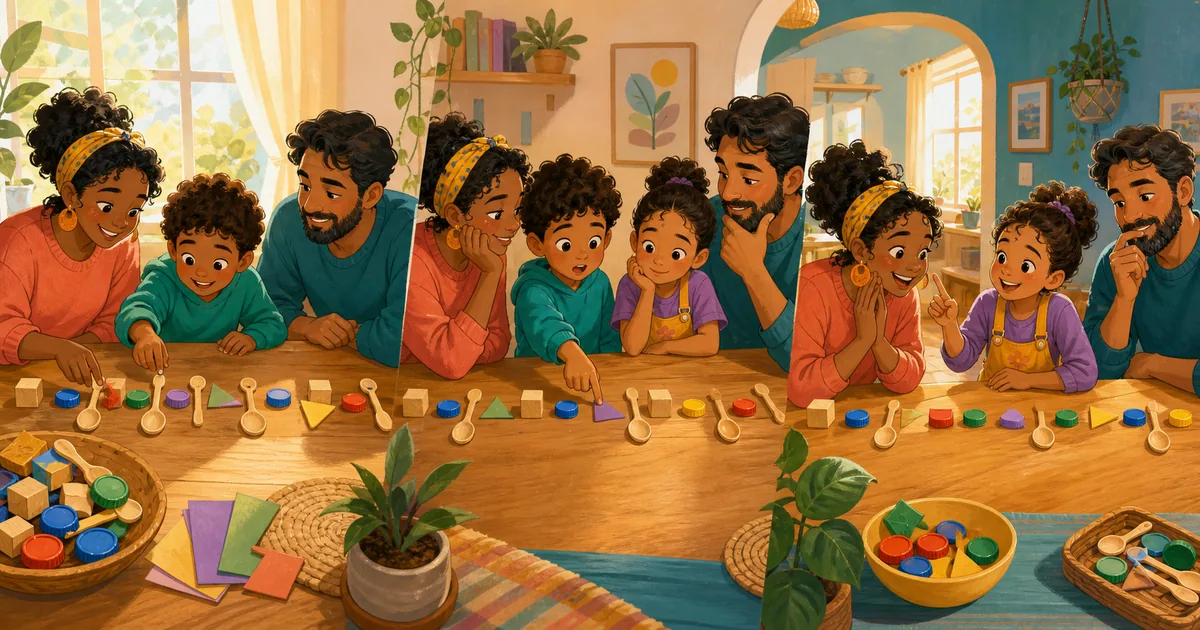
The rule-maker starts a simple sequence with large, safe objects: wooden spoon–colored card–wooden spoon–colored card, for example. Leave the final place empty.
Try this: After asking what comes next, always ask, “Which clue made you think that?” Listen to more than one explanation when the pattern allows it.
2. Discover a hidden rule
Now make the rule less obvious. Instead of alternating colors, the sequence might alternate materials: wood–paper–wood–paper. Players test whether a new object belongs.
Try this: The rule-maker says only “fits” or “does not fit,” then adds another example. Do not reveal the rule after the first guess.
3. Compare two possible explanations
A short sequence can support more than one idea. Red card–blue block–red card might appear to follow either a color rule or a material rule.
Try this: Ask for two possible rules, then choose one new object that would separate them. The point is to design a fair check, not to trick another player.
4. Let the child design the rule
For the final round, the child builds the sequence. Help them keep the rule consistent without taking it over. Adults should make genuine guesses and explain their reasoning too.
Try this: Close with, “Which clue helped most?” and “How would you make the rule one step more challenging?”
A 5-minute safe setup
Prepare the table and agree on how clues will work before the first round.
1 minute · Pick large, safe objects
Use 8–12 items such as wooden spoons, socks, large blocks, thick colored cards, or paper shapes. Leave out anything sharp, hot, breakable, magnetic, battery-powered, or small enough to swallow.
1 minute · Make the first rule easy
Start with one feature—color, material, shape, or direction. Combine two features only after everyone understands the game.
1 minute · Agree on the clue format
The rule-maker may say “fits/does not fit” or add another example to the sequence. Teasing, rushing, and deliberately misleading clues are not part of the game.
2 minutes · Model one practice round
An adult can think aloud without giving away the answer: “I see two wooden objects. I wonder if material matters.” This models explaining evidence, not simply announcing a guess.
Keep the game safe and enjoyable
If a younger sibling is nearby, do not use anything that could fit in a mouth. Avoid food, medicine, batteries, magnets, blades, glass, and hot objects. An adult should check every item for the children and home involved. No internet connection, photo, location, or personal information is needed.
If someone is repeatedly stuck, add a clear example, reduce the choices, or simplify the rule instead of saying they failed. Do not compare children by speed, and let anyone pause or leave a round. This activity is not an IQ measure, diagnosis, or school-performance assessment.
Carry the same thinking into a game
After the tabletop activity, choose one Zeka.land game with a visible source and license. An adult should read its detail page first. Keep the conversation on rules and strategies rather than scores.
Sources
- Activities Guide: Enhancing and Practicing Executive Function SkillsCenter on the Developing Child at Harvard University ↗
- Executive Function Activities for 7- to 12-year-oldsCenter on the Developing Child at Harvard University ↗
- Finding Math in Everyday Family LifeDREME Network, Stanford University ↗
This guide was drafted with AI assistance. Its sources, activity steps, child-safety language, and English localization were editorially checked during publication preparation.