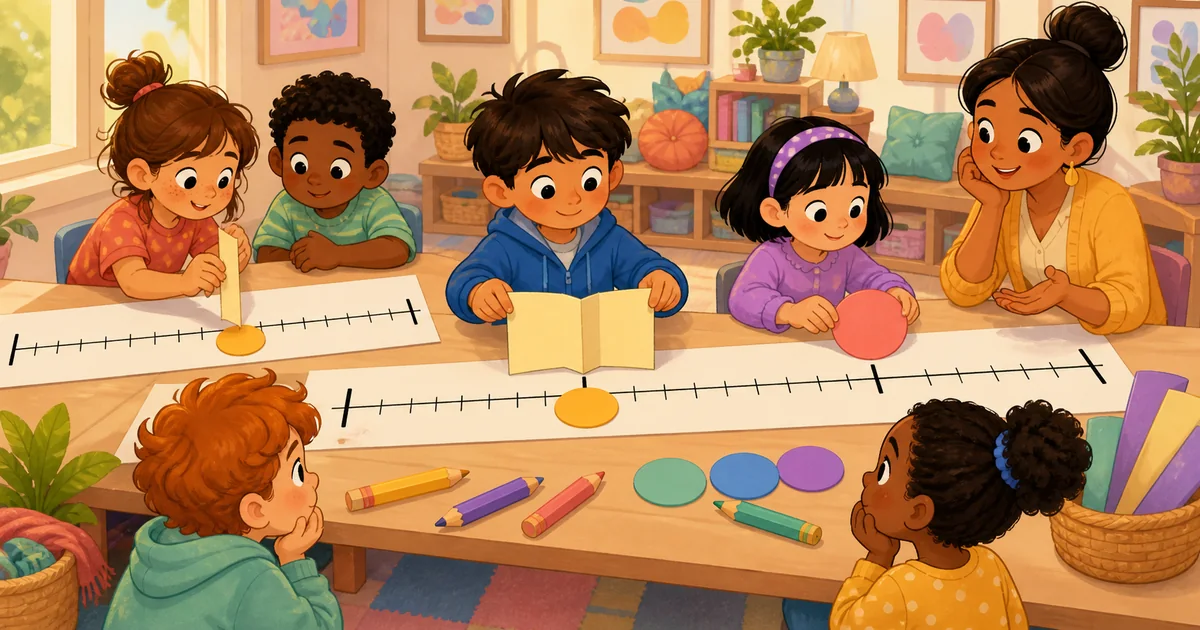
A useful estimate is not a random mark
A number line shows more than which number comes first: it represents approximate distance too. To place 67, a child can locate the stretch from 50 to 100 and decide whether 67 is closer to 50 or 100. The estimate becomes a mathematical judgement anchored to known points.
The US Department of Education’s What Works Clearinghouse guide recommends carefully chosen concrete and visual representations, clear mathematical language, and number lines to support conceptual understanding. England’s Department for Education guidance similarly asks learners to consider both endpoints and the midpoint when estimating a value on an unmarked number line, then justify a reasonable location from those landmarks.
The Education Endowment Foundation notes that manipulatives and representations such as number lines should stay connected to the mathematical idea rather than becoming the task themselves. The adult therefore does not place the mark for the child. Ask, “Which two landmarks surround it?” and “Is it before or after halfway?” This is not a test of intelligence or IQ: there is no timer, score, ranking, or comparison between children.
A 0–100 number line in 4 rounds
Place two sheets of paper side by side along their long edges, or use one long sheet of packing paper. A thick pencil and a few large paper cards are enough. Keep the line on a table, not on the floor.
1. Build the endpoints and midpoint
Write 0 at the left end and 100 at the right. Fold the paper gently in half, open it, and write 50 under the crease.
Try this: Ask, “Why does 50 belong in the middle?” Let the child explain that the intervals from 0 to 50 and from 50 to 100 are equal.
2. Estimate the quarter points
Prepare large cards for 25 and 75. Place 25 about halfway from 0 to 50, then place 75 about halfway from 50 to 100.
Try this: Before measuring, ask which landmarks surround each card and how close it is to each one. Use only a visual check afterwards.
3. Place four numbers with reasons
Call out 18, 43, 67, and 92 one at a time. For each number, the child draws a short upright mark and writes the number below it.
Try this: Complete three sentences each round: “It is between ... and ...” “It is closer to ...” “I know because ...” Look for reasoning that fits the number order, not perfect placement.
4. Compare two nearby numbers
Place 46 and 54 on the same line. Notice that both are close to 50, but one belongs to its left and the other to its right.
Try this: If the child wants to move a mark, ask what new idea changed the decision. Showing the first and revised estimates in different colors makes the learning visible.
A four-question position check
Use the same short sequence for each new number so every estimate can be explained with landmarks.
1. Which two landmarks surround it?
Start with a known interval—0 to 50 or 50 to 100—then narrow that interval if useful.
2. Is it before or after halfway?
Picture the middle of that interval and decide on which side the number belongs.
3. Which endpoint is closer?
Compare the number’s distance from both landmarks, then state the decision in a full sentence.
4. Does the position make sense?
Check the order against nearby marks. Revise when there is new evidence, and explain the reason for the change.
Keep the activity safe and supportive
Keep the number line on a table; do not tape it to the floor for stepping or jumping. Choose large sheets and child-safe pencils. An adult should do any cutting in advance. Leave out small, sharp, breakable, magnetic, or battery-powered pieces.
If 0–100 feels too demanding, switch to 0–10 and use only 0, 5, and 10 as landmarks. Do not provide the answer. Offer a starting choice such as “left or right?” No account, camera, location, school detail, photo, or other personal information is needed.
Talk about number relationships in a game
After the tabletop activity, choose one of these Zeka.land number games with visible source and license information. An adult should read the game details first. Rather than chasing a score, ask, “What changes when this number grows?” or “Which size relationship guides the next move?”
Sources
- Assisting Students Struggling with Mathematics: Intervention in the Elementary GradesWhat Works Clearinghouse, Institute of Education Sciences ↗
- Mathematics guidance: key stages 1 and 2Department for Education, GOV.UK ↗
- Use manipulatives and representations to develop understandingEducation Endowment Foundation ↗
This guide was drafted with AI assistance. Sources, mathematical examples, activity steps, child-safety language, original artwork, and English localization were editorially checked before publication.