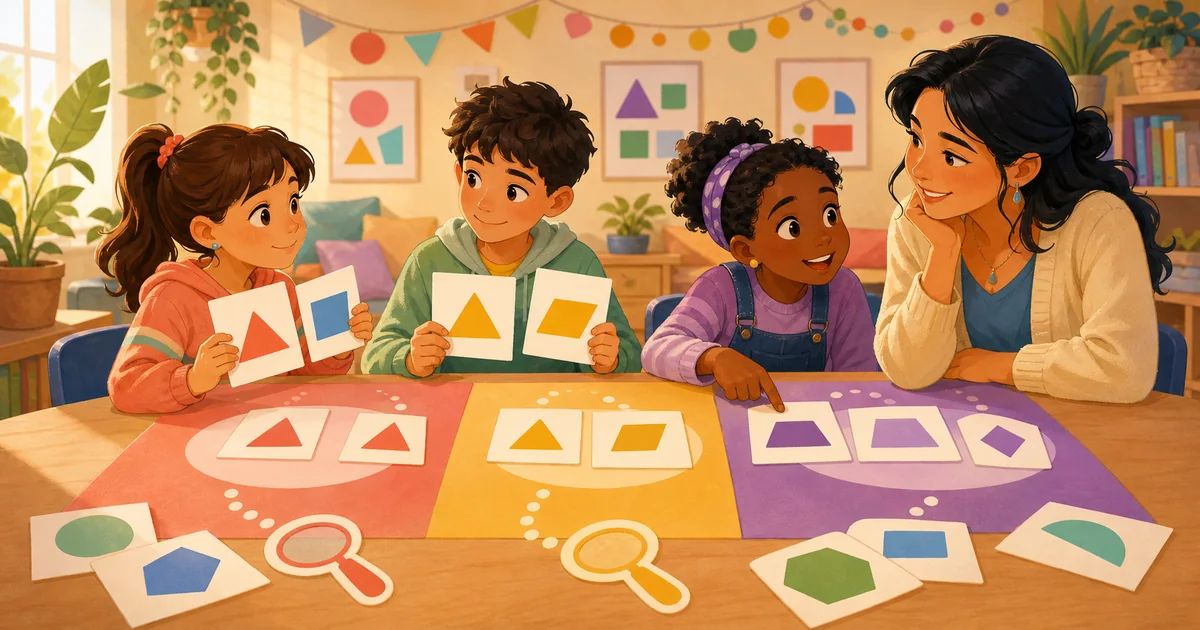
Testing a statement is different from guessing an answer
Logical claims need clear boundaries. If a statement says “always,” one counterexample is enough to disprove it. “Sometimes” needs both a case where the statement works and a case where it does not. For “never,” look for a possible example; if none exists, explain which conditions cannot occur together.
The University of Cambridge NRICH activity asks learners to sort statements as always, sometimes, or never; build examples and counterexamples; and explain the conditions that make a “sometimes” statement true. The US Department of Education’s What Works Clearinghouse guide also highlights monitoring and reflecting on problem solving, using visual representations, and comparing more than one strategy.
The EEF’s current metacognition guidance recommends that adults model their thinking aloud and support learners with planning, monitoring, and evaluating questions. This tabletop activity is not an intelligence, IQ, personality, or developmental test. It does not score or label children by speed or by the number of cards sorted correctly.
Logic Detectives: 4 card rounds
Label three large sheets “Always,” “Sometimes,” and “Never.” Prepare three statement cards plus a few large paper triangles, quadrilaterals, and squares. An adult should do any cutting in advance.
1. Define the three words
Always: true for every suitable example. Sometimes: true for some examples but not others. Never: not true for any suitable example.
Try this: Ask the child to restate each meaning. Make it clear that “sometimes” does not mean “I am not sure.”
2. Sort three claims
Use these cards: “A paper shape with three corners has three corners.” “A paper shape with four corners is a square.” “One paper shape has exactly three and exactly four corners at the same time.”
Try this: The child places each card. Before confirming anything, ask, “Which shape could show why you chose that area?”
3. Hunt for a counterexample
Try to break the “always” card with one example. For the “sometimes” card, show both a square and a four-cornered shape that is not a square. For “never,” ask whether both exact corner counts can be true together.
Try this: When a counterexample appears, ask, “Which part of the statement did this example change?” instead of silently moving the card.
4. Rewrite the claim precisely
Add the missing conditions to “A four-cornered shape is a square.” For example, state that the shape has four equal sides and four right angles.
Try this: For the final round, the child invents a “sometimes” statement. The adult tries to build one case where it is true and another where it is false.
A four-question claim check
Use the same sequence for each new card so the decision grows from evidence rather than a quick guess.
1. What exactly does the statement say?
Find boundary words such as “all,” “some,” or “none,” and define the objects being discussed.
2. Can we build a supporting example?
Choose or draw a shape that fits the claim, then name the feature that makes it work.
3. Can we find a counterexample?
Look for one case that meets the starting condition but breaks the result; do not discard the first idea too quickly.
4. What evidence would change our decision?
When a new example appears, reconsider the card and rewrite the statement more precisely if needed.
Keep the activity safe and supportive
Use large paper cards and keep small pieces away from younger siblings. An adult should complete any cutting. There is no blindfolding, running, or use of hot or breakable objects; paper shapes on a table are enough.
If the task feels difficult, offer a choice between two areas or start with one example. Do not supply the answer or compare the child’s speed. No account, camera, location, school detail, photo, or other personal information is needed.
Use the same logic questions in a game
After the card activity, choose one of these Zeka.land logic games with a visible source and license. An adult should read the detail page first, then ask which clues support or rule out a move instead of revealing the answer.
Sources
This guide was drafted with AI assistance. Its sources, activity steps, child-safety language, artwork, and English localization were editorially checked during publication preparation.