Fraction comparisons begin by seeing the same whole
The US Institute of Education Sciences practice guide recommends treating fractions not only as “parts of a whole” but as numbers that represent quantities. It uses number lines, measurement situations, and fraction strips to support that idea. Crucially, the size of a half-strip depends on the length chosen as the original whole.
England’s Department for Education guidance connects fractions of lengths, shapes, sets, and quantities with equal sharing and grouping. It also asks pupils to recognise equivalence such as 2/4 and 1/2. “Equal” is the essential word: naming the number of pieces is not enough unless those pieces are the same size.
The Education Endowment Foundation notes that manipulatives can help children make sense of mathematical ideas when adults explicitly connect the object to the idea it represents. A paper strip is therefore a tool for showing thinking, not an answer by itself. Keep asking, “What does this fold represent?” and “Did our whole change?”
Six steps to try at the table
You need three colours of paper, a pencil, and a flat surface. An adult can prepare equal-length strips in advance; never ask for a child’s personal information or photograph.
1. Fix the reference whole
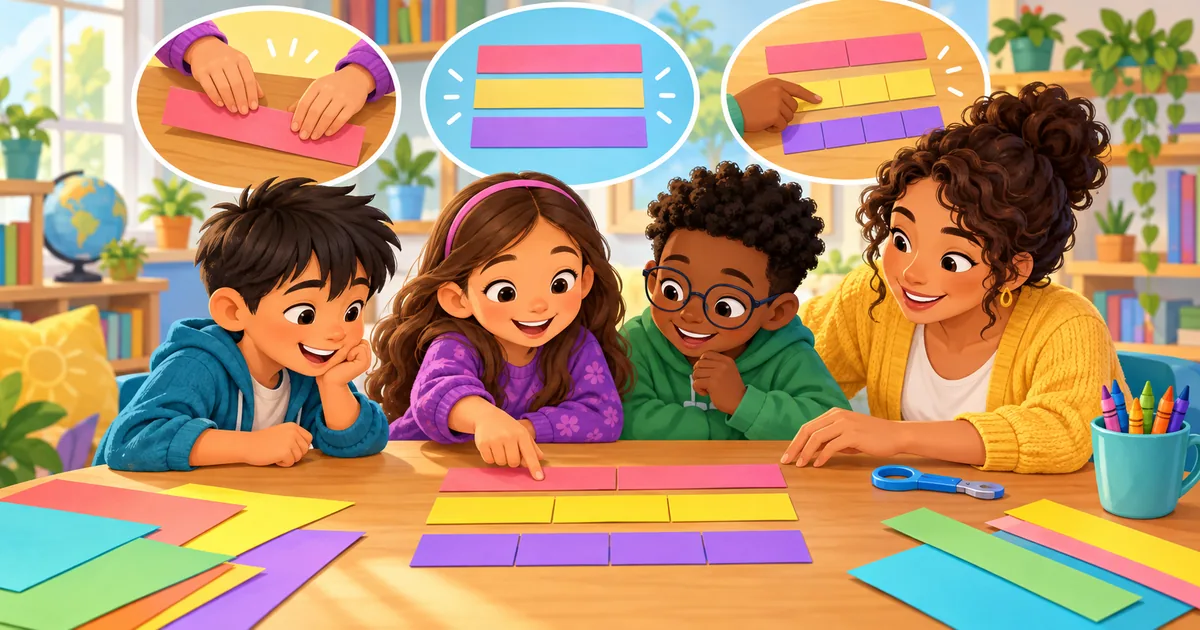
Prepare three strips with exactly the same length and width. Stack them with their starting edges aligned so everyone can check that each strip represents the same whole.
Try this: Ask the child to explain “Each strip is one whole” in their own words. If the lengths differ, correct them before continuing.
2. Fold equal parts
Fold one strip into halves, one into thirds, and one into quarters. Open them and check, by sight and by overlapping, whether the sections are equal in size.
Try this: If the sections are unequal, stop counting, unfold, and try again. Four sections are not automatically four quarters.
3. Compare unit fractions
Place one half, one third, and one quarter at the same starting line. Decide which piece is longer by aligning them, not merely by looking at the denominators.
Try this: Ask, “When the same whole is split into more equal parts, what happens to each part?” Let the strip support the rule instead of demanding it first.
4. Make equivalence visible
Place two quarter-pieces end to end over a half-strip. Check whether their final edges meet at the same point.
Try this: Invite a proof sentence such as, “Two quarters cover the same length as one half,” linking 2/4 and 1/2 to visible evidence.
5. Try the different-whole trap
Compare half of a new, shorter strip with one quarter of the original long strip. Physical length may now contradict a guess based only on the fraction names.
Try this: Ask, “Do these fractions use the same whole?” Agree that a fair comparison needs the reference whole to be stated first.
6. Explain with three pieces of evidence
For any pair, the child identifies the whole, the number of equal parts, and the point where the aligned strips end. Another child may explain the same result differently.
Try this: Do not score speed. Ask, “Where can you see that on the strip?” to connect the conclusion to evidence.
A four-round, 15-minute routine
Reuse the same strips. In every round, the adult asks for the comparison rule instead of supplying the answer.
1. Check the whole — 3 minutes
Stack the strips and match both ends. Discuss why each full strip can represent one whole.
2. Fold and name — 4 minutes
Make halves, thirds, and quarters. Show that the parts must be equal and that counting crease lines alone is not enough.
3. Compare and build equivalence — 5 minutes
Align 1/3 with 1/4, then 1/2 with 2/4. Predict first, check with the strips, and explain why an idea changed if it did.
4. Invent a question — 3 minutes
The child chooses two strips and asks which is larger, smaller, or equivalent. They show the answer with the placement and a short reason.
Two common misconceptions and a safe setup
A larger denominator does not make a fraction larger. When the same whole is divided into more equal parts, each unit part becomes smaller. If the wholes differ, however, comparing the physical sizes of pieces named 1/2 and 1/4 can mislead. Return to “Are the wholes the same?” before every explanation.
An adult can cut the strips beforehand. If a child uses scissors, choose an age-appropriate safety tool and provide close adult supervision. The activity can stay entirely offline: no name, school, photograph, location, or result is recorded. It is not a test, grade, IQ measure, or diagnosis.
Keep seeing quantities in different ways
After the paper activity, use Set Sizes & Shapes to group quantities, Game of Sums to compose a whole in different ways, or 2048 to notice equal tiles combining with an adult. Treat any game score as a prompt for conversation, never as a measurement of the child.
Read alongside this guide
Sources
- Developing Effective Fractions Instruction for Kindergarten Through 8th GradeUS Institute of Education Sciences ↗
- National curriculum in England: mathematics programmes of studyUK Department for Education ↗
- Use manipulatives and representations to develop understandingEducation Endowment Foundation ↗
- Fraction LengthsNRICH Mathematics ↗
This guide was drafted with AI assistance. Its mathematics, sources, child-safety framing, original artwork, and English localization were editorially checked during publication preparation.