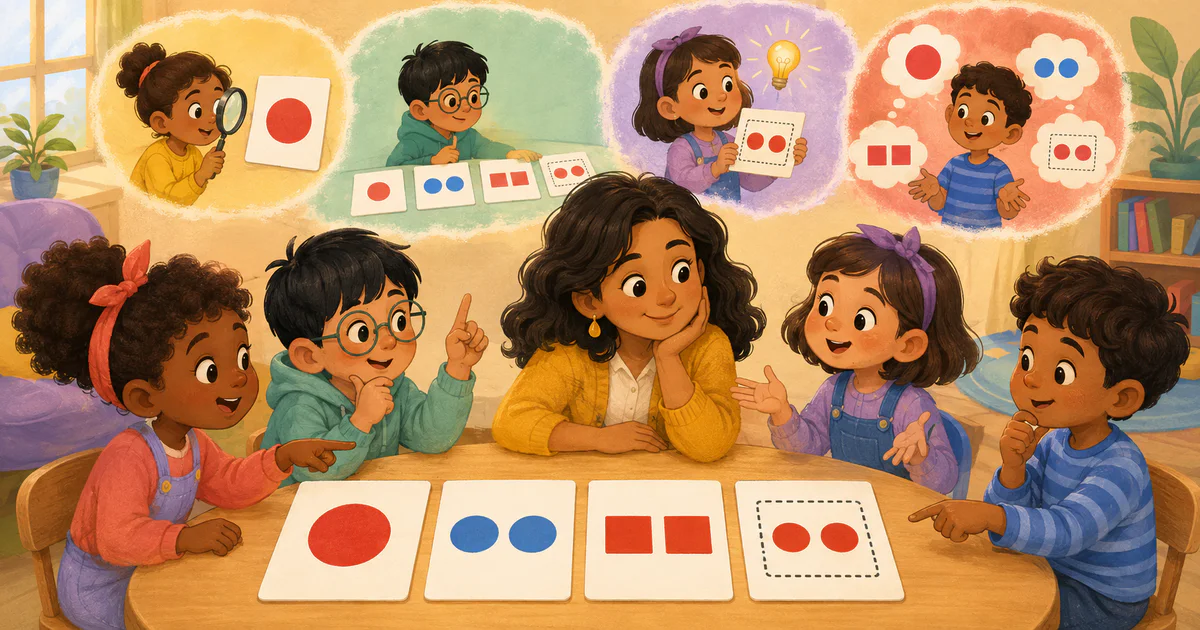
A useful answer reveals the reasoning
Harvard Project Zero’s See, Think, Wonder routine separates close observation from interpretation and asks learners to connect ideas to evidence. This game follows that principle: children begin with features they can actually see—such as “blue,” “two,” or “square”—before deciding which card stands apart.
Open classification tasks from the University of Cambridge’s NRICH project encourage children to name groups in more than one way and accept different “does not belong” choices when the reason fits. The adult therefore does not treat one private answer key as the goal. A new answer is worth considering when the rule is clear and the evidence is visible on all four cards.
The Standards for Educational and Psychological Testing explain that score interpretations require evidence for a defined purpose, suitable administration, and qualified use. Four homemade cards provide none of that. This activity is not an IQ test, intelligence measure, diagnosis, age estimate, or school-readiness assessment. There is no score and no comparison between children.
Four cards, four defensible choices
Make four large paper cards. The drawings do not need to be perfect, but each feature should be easy to see from across the table.
1. Build the cards from visible features
Draw one large red circle on Card A; two small blue circles on B; two small red squares on C; and two small red circles inside a dotted border on D.
Try this: Shuffle the cards and lay them on the table. The letters are only convenient names for the adult; they do not need to appear on the children’s cards.
2. Observe before choosing
Do not begin with “Which is different?” Gather observations about colour, shape, quantity, size, and borders first.
Try this: Ask, “Can you name three things you see without deciding yet?” If a label such as “smarter” appears, return to evidence: “What can you see on the card that led to that idea?”
3. Choose a card, state the rule, show the evidence
Any card can be chosen. A is the only card with one shape; B is the only blue card; C is the only one with squares; D is the only card with a border.
Try this: Build a three-part sentence: “I choose ...; my rule is ...; my evidence on the cards is ...”. The answer works when the rule and evidence match.
4. Find a second answer with the same cards
After accepting the first explanation, find a new rule that makes another card stand apart. Then explore what happens if one visible feature changes.
Try this: Ask, “What small change would break your rule?” Let the child redraw a card or direct the adult; do not design the solution for them.
From choice to explanation in 4 moves
Use the same sequence with each new card set. The purpose is not to collect answers, but to make a line of reasoning understandable.
1. Notice
List directly visible features such as colour, shape, quantity, size, and boundary without announcing a conclusion.
2. Name the rule
Explain in one sentence which single feature or clear relationship you mean by “different.”
3. Point to the evidence
Show the feature on the chosen card, then check how each of the other three fits the rule.
4. Test the boundary
Consider a new rule or counterexample. If your idea changes, say which new piece of evidence changed it.
Keep it safe, inclusive, and score-free
Do not time the child, award levels for the number of answers, or use labels such as “smart,” “slow,” or “good for your age.” Language, vision, attention, or motor needs can shape how someone explains. A child may point, group cards, or direct an adult to draw instead of speaking, and may stop a round at any time.
Use large paper and child-safe markers. An adult should do any cutting in advance. Leave out small, sharp, breakable, magnetic, or battery-powered pieces. The activity needs no screen, account, photograph, location, or other personal information.
Carry the reasoning into a game
After the cards, choose a Zeka.land game that plays on-site and shows its source and licence. An adult should read the detail page first. Talk about rules and evidence rather than scores.
Sources
This guide was drafted with AI assistance. Its sources, non-diagnostic framing, activity steps, child-safety language, and English localization were editorially checked during publication preparation.