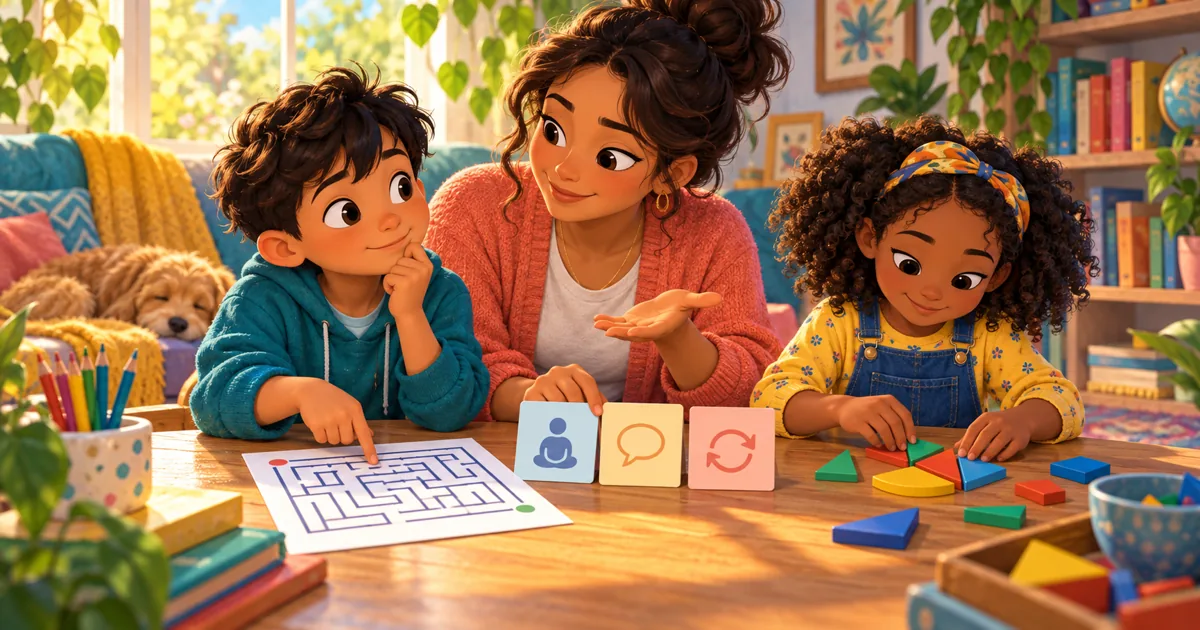
Helpful support makes a thinking path visible
Self-regulation in learning includes habits such as planning a task, monitoring progress while trying, and evaluating what worked afterwards. The Education Endowment Foundation recommends that these strategies are modelled explicitly and scaffolded gradually within a specific subject or task, rather than used as a slogan on their own.
The US Institute of Education Sciences guide on mathematical problem solving includes open prompts that help children understand a problem, choose a route, and check whether a solution makes sense. Here, those prompts are not an assessment or a test. They are a small scaffold for letting a child hear their own thinking.
Instead of “Don’t you know?” or “No, that’s wrong,” choose one neutral question about the task. Wait for the child’s answer, return to one small choice, and look together at what their trial shows. Do not attach labels to speed, scores, or the number of correct answers.
Five steps for a stuck moment
You only need a puzzle, paper and pencil, or a suitable Zeka.land game. Do not record or request a child’s name, school, photograph, location, or result.
1. Make a short pause
If the child seems bored, upset, or rushed, pause before explaining the solution. “Shall we look for a moment?” signals a move into thinking, not failure.
Try this: Wait without supplying an answer. If the child wants a break, do not push: a drink, a stretch, or returning later are all valid choices.
2. Ask for the task in the child’s words
Ask, “What are you trying to find out in this puzzle?” The child may name only the goal, a rule, or the first clue they notice; do not rush to correct the sentence.
Try this: If helpful, reflect it back in one short sentence: “So you are working out which exit this path reaches.”
3. Choose one visible clue
Rather than tackling the whole puzzle at once, choose one shape, starting point, repeating rule, or empty square. “Which small part could we look at first?” is enough.
Try this: Do not choose and point to the clue for the child. If they are torn between two options, simply name the options and let them choose.
4. Try one small move
Asking for just one move, line, or prediction makes the task manageable. An unsuccessful trial is information about a route that did not work.
Try this: Ask, “What did you notice from that try?” Do not yet give the correct answer or next move.
5. Look back at the method
When the puzzle is finished—or when it is time to pause—ask, “What did you do first, and what changed next?” The focus is noticing a useful strategy, not praising an outcome.
Try this: Let the child choose one method for their next puzzle: describing the rules first, choosing a small part, or checking a trial.
A calm 10-minute helping routine
You do not need every step for every puzzle. Reduce the steps when a child is overloaded; reduce adult talk when they are moving forward on their own.
1. Start — 2 minutes
Listen for one sentence about the child’s goal and the puzzle rule. Set out what is needed and remove phone notifications or time pressure.
2. One clue — 3 minutes
The child picks a small area. The adult asks one open prompt only, such as “What do you notice?” or “What could we check first?”
3. Try and check — 3 minutes
Make one move, then observe its result. If it does not work, the child picks a new small trial. There is no penalty, teasing, or score for being wrong.
4. Close — 2 minutes
The child names a thinking step they might reuse. It is fine not to finish: “We can stop here and look again tomorrow with fresh eyes.”
When to stop and when to seek support
This routine does not measure a child’s worth, intelligence, achievement, or skill level. If there is persistent intense distress, anxiety, difficulty affecting school life, or a safety concern, do not use this activity as a diagnosis. A parent or guardian can decide whether to speak with the school guidance service or an appropriate professional who knows the child.
Adult help is not meant to take control. If a child says “I do not want help,” respect the pause. In an online game, never share a child’s personal information, school name, photograph, location, or contact details; avoid open chat spaces and contact with strangers.
Practise the thinking step through play
In the Maze game, first describe one turn; then look at just one row in Star Battle, or say one rule aloud in 0h h1. Treat a score not as a measurement but as the start of “Which clue helped?” conversation.
Read alongside this guide
Sources
This guide was drafted with AI assistance. Its sources, child-safety framing, original artwork, and English localization were editorially checked during publication preparation.